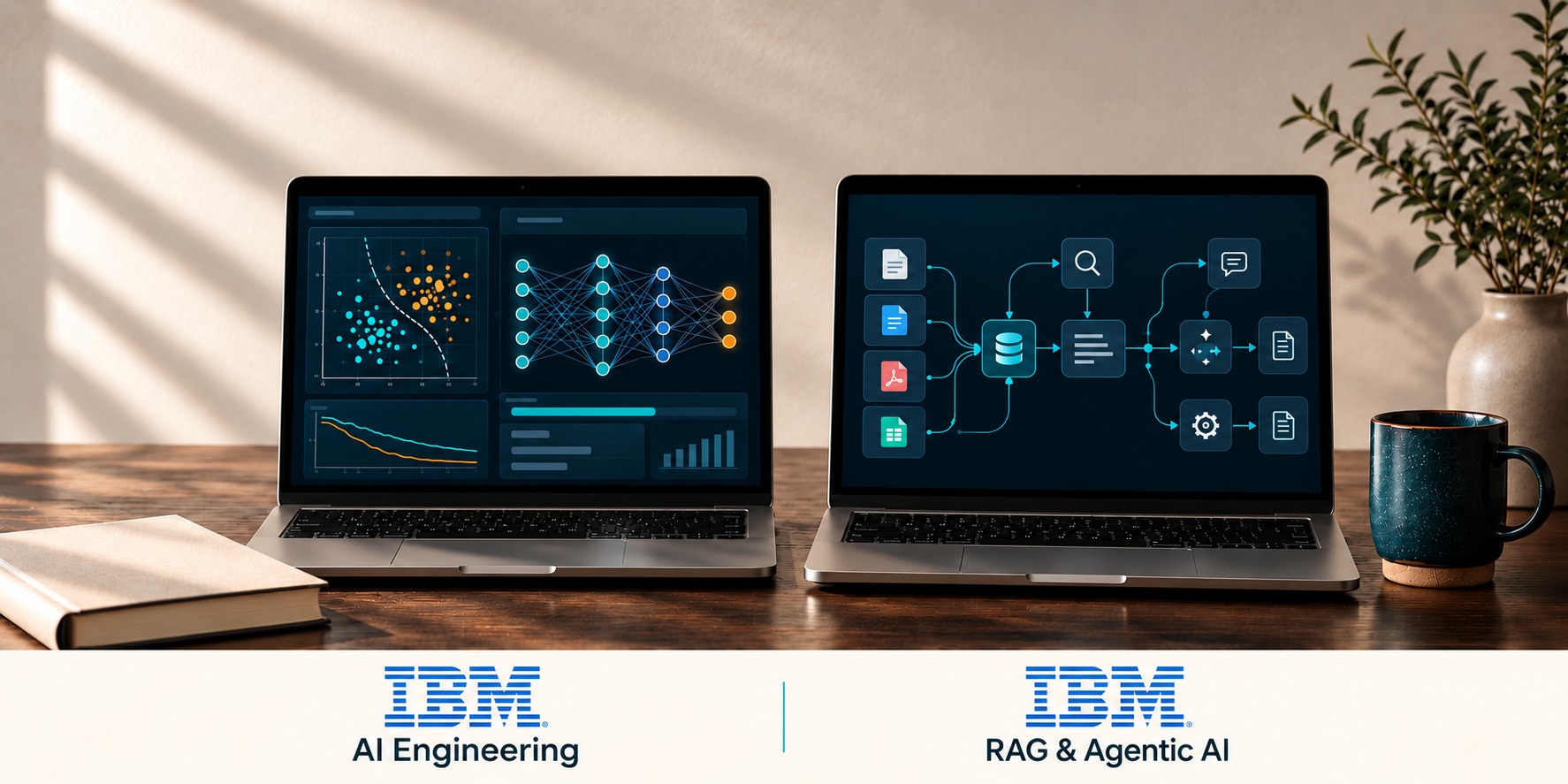
Course comparison · Updated 7 November 2026
IBM AI Engineering vs RAG and Agentic AI: which fits you?
Compare IBM’s two AI certificates by prerequisites, syllabus overlap, projects, workload and cost. Choose model-building foundations or a RAG and agents focus.
Estimated reading time: 7 min
Quick answer
Choose AI Engineering for a broader machine-learning and deep-learning pathway. Choose RAG and Agentic AI when you already have technical preparation and want to build retrieval and agent applications.
Editorial assessment of published provider information and learner fit. We have not independently tested these courses or measured learner outcomes.
The choice is between broader model-building training and a more focused application-building path. IBM AI Engineering includes machine learning, deep learning and generative AI. IBM RAG and Agentic AI concentrates on retrieval, tools and agent workflows. Both include practical work, and neither should be chosen only for the certificate name.
IBM certificates compared
| Decision | IBM AI Engineering | IBM RAG and Agentic AI |
|---|---|---|
| Current structure | 13 courses; intermediate | 10 courses; advanced |
| Learning emphasis | Machine learning, neural networks and generative AI | Retrieval, LLM applications and agent orchestration |
| Useful preparation | Python and readiness for model-building concepts | Python, software development and basic LLM application concepts |
| Project emphasis | Deep-learning project and a RAG/LangChain application | Integrated retrieval and agentic AI capstone |
| Time planning | Headline: four months at 10 hours/week | Headline and course-hour totals disagree; plan from the course list |
| Access and cost | Check regional assessed access and subscription inclusion | Check regional assessed access and subscription inclusion |
Choose AI Engineering for a broader technical base
The published sequence begins with machine learning and neural-network development, then extends into generative AI. It uses Python libraries including scikit-learn, Keras and PyTorch. The later sequence also includes a RAG/LangChain application project.
That breadth matters when you want to understand modelling choices as well as how to connect an LLM to documents. A learner moving from data analysis toward model-building has a different need from a developer who already knows the foundations and wants retrieval workflows.
The trade-off is time spent on material that might not be your immediate task. If you already train and evaluate models, inspect the individual courses before paying for another broad sequence. Read the IBM AI Engineering review for the programme overview.
Choose RAG and Agentic AI for LLM applications
The ten-course programme focuses on retrieval, vector databases and agent systems. Its published topics include LangGraph, multi-agent tools, multimodal applications and the Model Context Protocol. The capstone brings retrieval and agent components together.
It is the more direct fit for a developer whose next project involves searching a document collection, calling tools or coordinating a multi-step application. It is not a substitute for learning to program, and the advanced label deserves attention.
Framework-focused study also requires you to work through changing libraries and documentation. Assess whether you want a broad guided sequence or a shorter course for one immediate skill. See the RAG and Agentic AI review and the IBM vs Hugging Face comparison for that second decision.
How much curriculum overlaps?
We compared the course URLs in both public lists on 7 November 2026. None of the 13 AI Engineering component URLs appears in the ten-course RAG and Agentic AI list. That is a check of course identity, not proof that the programmes share no concepts or exercises.
| Learning area | AI Engineering | RAG and Agentic AI |
|---|---|---|
| Model-building foundations | Courses 1–6 cover classical ML, neural-network libraries and a deep-learning capstone. | Its sequence starts with generative-AI applications rather than this model-building block. |
| Language models and retrieval | Courses 7–11 cover LLM preparation, architectures and fine-tuning; courses 12–13 introduce agents and a RAG application. | Courses 1–5 concentrate on applications, retrieval, vector databases and multimodal work. |
| Agent frameworks and integration | The final two courses provide related application topics. | Courses 6–10 develop agents, orchestration, MCP and a dedicated capstone. |
Inspect the 13 AI Engineering course titles and sources
- Machine Learning with Python: Build Real-World ML Models
- Introduction to Deep Learning & Neural Networks with Keras
- Deep Learning with Keras and Tensorflow
- Introduction to Neural Networks and PyTorch
- Deep Learning with PyTorch
- AI Capstone Project with Deep Learning
- Generative AI and LLMs: Architecture and Data Preparation
- Gen AI Foundational Models for NLP & Language Understanding
- Generative AI Language Modeling with Transformers
- Generative AI Engineering and Fine-Tuning Transformers
- Generative AI Advanced Fine-Tuning for LLMs
- Fundamentals of AI Agents Using RAG and LangChain
- Project: Generative AI Applications with RAG and LangChain
Inspect the ten RAG and Agentic AI course titles and sources
- Develop Generative AI Applications: Get Started
- Build RAG Applications: Get Started
- Vector Databases for RAG: An Introduction
- Advanced RAG with Vector Databases and Retrievers
- Build Multimodal Generative AI Applications
- Fundamentals of Building AI Agents
- Agentic AI with LangChain and LangGraph
- Agentic AI with LangGraph, CrewAI, AutoGen and BeeAI
- Build AI Agents using MCP
- RAG and Agentic AI Capstone Project
The practical overlap is in the problems discussed, especially generative AI, retrieval and LangChain. The learning paths place different emphasis on those problems. We have not established automatic cross-certificate credit or a waiver of assessments. Confirm recognition of any completed course with Coursera before buying on that assumption.
Choose a sequence around the missing skill
- You need to train and evaluate models: investigate the engineering foundations, then assess whether a focused retrieval course fills a later gap.
- You already have the foundations: inspect the application sequence first and avoid repeating subjects you can already demonstrate.
- You completed AI Engineering: compare the retrieval, vector-database and agent components with your next project before purchasing the full second certificate.
Workload and cost
AI Engineering’s headline estimate is four months at ten hours per week. RAG and Agentic AI advertises eight weeks at three hours per week, but its ten individual estimates totalled 103 hours when rechecked on 17 November 2026. Plan from that longer workload and allow extra time for debugging and project extensions.
Neither programme has one universal total price for every learner. Confirm assessed access, certificate inclusion, billing frequency and any Coursera Plus coverage in your account. A longer study period can increase the cost of a monthly plan.
Do not subscribe to both simply to collect IBM badges. First identify what you need to produce, how much of the syllabus is new to you and how much weekly study time you can maintain.
A project test for choosing between them
Write a one-paragraph brief for the work you want to complete. If it involves preparing data, comparing trained models and explaining validation results, investigate the broader engineering path. If it involves retrieving evidence, managing tool calls and evaluating an LLM application, investigate the RAG path.
Alongside either course, develop one example you can explain without following a tutorial. Record the data, the choices you made and where the result fails. This is our suggested extension, not a promise about the providers’ marking or a guarantee of employment.
For a wider technical shortlist, see the developer course guide. If you need fundamentals first, compare CS50 AI and Andrew Ng.
Common questions
Which IBM certificate is better for beginners?
Neither is a first introduction to programming. AI Engineering is labelled intermediate and RAG and Agentic AI advanced. Check your preparation and learn Python first if needed.
Does IBM AI Engineering already include RAG?
Yes. Its current thirteen-course sequence includes RAG and LangChain topics and an application project. The dedicated RAG and Agentic AI certificate goes further into retrieval and agent workflows.
Should I complete both IBM certificates?
Only if both address a clear learning need. Compare individual course objectives and ask how any prior completion is recognised before paying for overlapping study.
Which certificate is cheaper?
There is no universal answer. Regional subscription prices, included access and completion time affect the cost. Compare the current terms in your account.
Find a course for your learning goal
Compare the catalogue using your role, experience, goals, budget and study time.
Find my AI course →Provider information checked 7 November 2026. Sources: IBM AI Engineering curriculum, IBM RAG and Agentic AI curriculum. How we assess courses. Fees, syllabuses and availability can change.